

A geological journey into the formation of Tanzania’s most extraordinary gemstone.
By Exclusive Tanzanite | Gemstone Education
Deep beneath the ancient landscapes of northern Tanzania, nature created something extraordinary. Through millions of years of geological transformation, heat, pressure, chemical reactions, and mineral-rich fluids, a remarkable blue-violet gemstone emerged from the rocks of the Merelani Hills.
We know this gemstone as Tanzanite.
But before it becomes a beautifully cut gemstone, set in precious gold and worn as fine jewellery, Tanzanite exists as part of a much larger geological story.
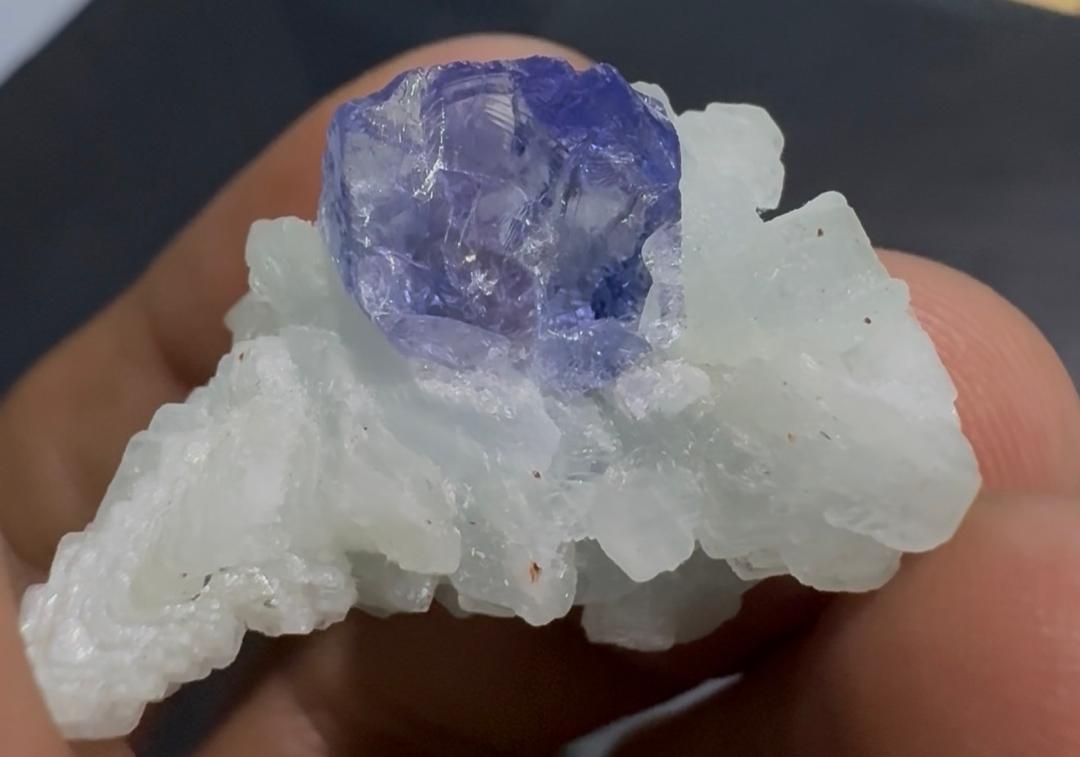
This natural specimen, featuring a purple-blue Tanzanite crystal attached to a white mineral matrix, offers us an opportunity to explore that story from its very beginning.
It allows us to appreciate not only the gemstone itself, but also the geological environment in which it developed.
A Crystal Still Connected to Its Origins
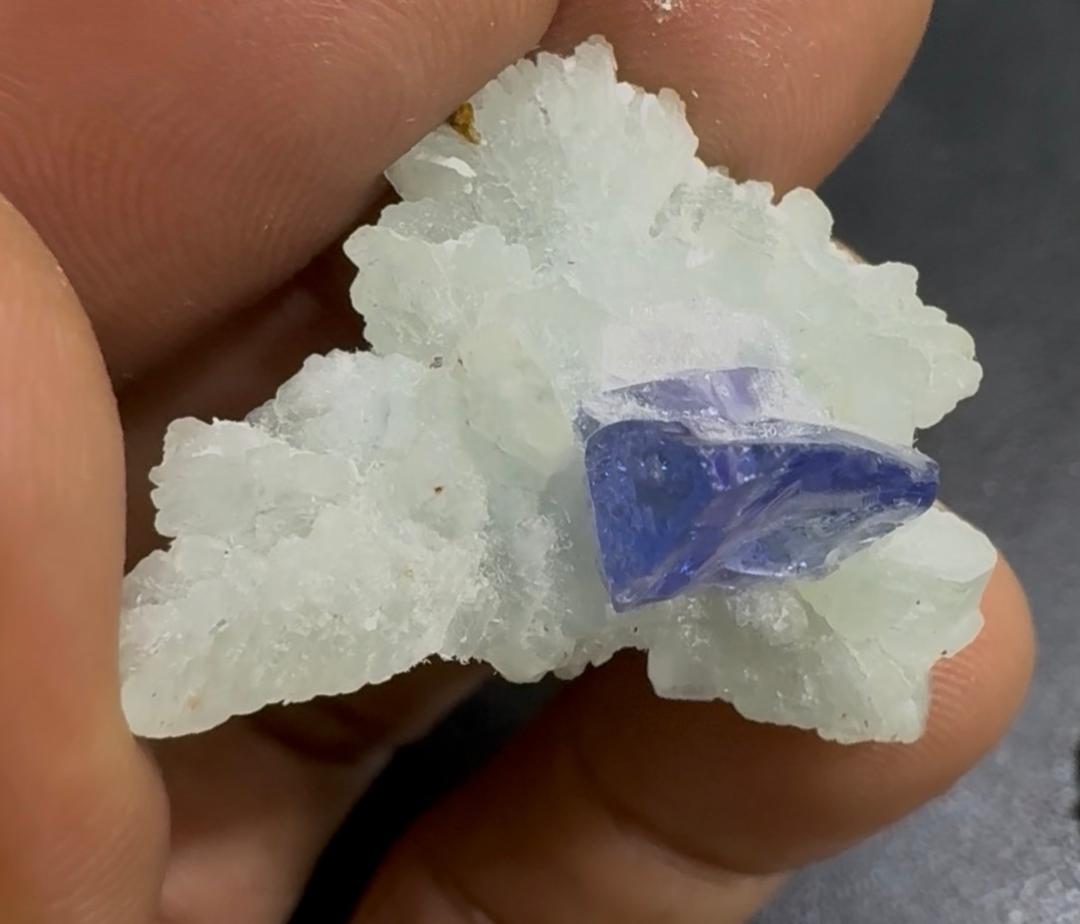
One of the fascinating features of this specimen is that the Tanzanite crystal remains attached to its surrounding mineral material, commonly referred to as its matrix.
In gemology, a mineral matrix provides valuable geological context. It can help researchers understand the environment in which a crystal developed and the minerals that were present during its formation.
The upper crystal displays a distinctive purple-blue appearance, characteristic of Tanzanite, the gem-quality variety of the mineral zoisite.
The surrounding white material appears crystalline. Although its exact mineral identity has not yet been laboratory-confirmed, calcite and other associated minerals are among the possibilities within the Merelani geological environment.
Rather than separating the crystal from its surroundings, preserving the specimen in its present condition allows us to appreciate its natural geological setting.
It is a reminder that every gemstone has an origin long before it reaches a jewellery workshop.
What Is Tanzanite?
Tanzanite is the blue-to-violet gem variety of zoisite, a calcium aluminium silicate mineral belonging to the epidote mineral group.
Its chemical formula is:
Ca₂Al₃(SiO₄)(Si₂O₇)O(OH)
One of its most remarkable characteristics is its association with vanadium, a trace element responsible for its distinctive blue-violet colour.
Tanzanite also displays an optical phenomenon known as pleochroism. This means that the gemstone can show different colours when viewed from different crystallographic directions.
Its three characteristic colour directions include blue, violet and brownish-yellow or yellow-green.
This optical property makes Tanzanite particularly fascinating to gemstone cutters, who carefully consider crystal orientation when planning how to cut a rough stone.
The objective is to reveal the most attractive colour while maintaining the beauty and weight of the original crystal.
How Was Tanzanite Formed? A Geological Story Millions of Years in the Making
The formation of Tanzanite is connected to the extraordinary geological history of the Merelani-Lelatema region in northern Tanzania.
Its development involved several geological processes.
1. Ancient Sediments: The Beginning
The story begins with ancient sedimentary materials deposited in an environment that existed hundreds of millions of years ago.
These sediments included clay-rich materials, silicate minerals, carbon-rich substances and carbonate components.
Over geological time, burial and geological transformation changed these original materials into metamorphic rocks.
Some carbon-rich materials transformed into graphite-bearing rocks, an important feature of the Merelani geological environment.
2. Heat and Pressure: The Transformation
As the original rocks were buried deep within the Earth’s crust, they experienced substantial heat and pressure.
This process, known as metamorphism, changed their original mineral composition and structure.
New minerals developed, existing minerals recrystallized, and chemical elements were redistributed.
The Merelani region experienced a complex metamorphic history associated with the ancient Pan-African geological events.
Importantly, the temperatures and pressures the surrounding rocks experienced during formation were not necessarily the same as those at which Tanzanite eventually crystallized.
3. Mineral-Rich Fluids: Nature’s Chemical Workshop
As tectonic activity deformed the rocks, fractures and other structural openings developed.
Mineral-bearing fluids moved through these geological pathways, interacting with the surrounding rocks.
These interactions helped redistribute important chemical elements, including calcium, aluminium, silicon and vanadium.
Vanadium is particularly significant because of its role in producing the characteristic colour of Tanzanite.
The interaction between the fluids and the surrounding rocks created conditions favourable for the development of new minerals.
4. The Birth of Tanzanite Crystals
Under suitable chemical and physical conditions, zoisite crystallized.
Vanadium became incorporated into the mineral’s crystal structure, contributing to the development of the blue-to-violet colours that make Tanzanite so distinctive.
Scientific studies have proposed crystallization conditions around 420°C and pressures of approximately 2–4 kilobars for Tanzanite formation, although estimates depend on the geological model and the specific stage being investigated.
This was not an overnight process. It was part of a much longer geological history involving the transformation of ancient rocks and the movement of mineral-bearing fluids.
The result was one of the world’s most extraordinary coloured gemstones.
Why Is Tanzanite Found Only in Tanzania?
Tanzanite is internationally recognised for its exceptionally restricted geographical occurrence.
Its established commercial source is the Merelani Hills in the Lelatema region of northern Tanzania, near Arusha.
The gemstone’s formation depended on a particular combination of geological conditions, including:
- Ancient sedimentary rocks with suitable chemical compositions.
- Metamorphic transformation under high temperatures and pressures.
- Tectonic structures that allowed fluid movement.
- The availability and redistribution of vanadium.
- Favourable conditions for zoisite crystallization.
It is this unusual geological combination that makes the Merelani deposit so important.
Tanzanite was first discovered in 1967 and subsequently introduced to the international gemstone market by Tiffany & Co., which gave it the name by which the world knows it today.
Its geographical uniqueness is an important part of its identity.
Unlike gemstones found across numerous countries, Tanzanite has a remarkable connection to one small geological region of Tanzania.
From Natural Crystal to Fine Jewellery
A natural Tanzanite crystal is only the beginning of its journey.
Before becoming a finished gemstone, it must be carefully evaluated by experienced gemstone professionals.
The rough crystal is examined for colour, clarity, fractures, inclusions, size and potential cutting orientation.
Its pleochroic properties are particularly important during the cutting process.
A skilled lapidary studies the crystal to determine how its natural colour can best be presented in the finished gemstone.
After cutting and polishing, the gemstone can be transformed into an elegant piece of jewellery.
It may eventually become a pendant, ring, bracelet or pair of earrings, crafted in precious metals and designed to complement the gemstone’s natural beauty.
At Exclusive Tanzanite, we appreciate this entire journey: from the geological origin of the mineral to the craftsmanship that gives it a new expression.
Why Preserving the Mother Rock Matters
A finished Tanzanite gemstone allows us to appreciate its colour, brilliance and beauty.
A crystal attached to its matrix offers something different.
It provides a physical connection to the geological environment from which the gemstone originated.
For collectors, mineral enthusiasts and gemstone students, specimens like this can offer educational and scientific value beyond their decorative appearance.
They also help tell a more complete story about Tanzania’s geological heritage.
Preserving the natural relationship between a crystal and its matrix, whenever possible, allows future generations to appreciate the remarkable processes responsible for creating these minerals.
Exclusive Tanzanite: Guardians of a Geological Legacy
At Exclusive Tanzanite, we believe that understanding a gemstone makes owning it even more meaningful.
Tanzanite is more than a beautiful blue-violet gemstone. It represents an extraordinary geological history, a unique part of Tanzania’s natural heritage and the skill of generations of people involved in bringing its beauty to the world.
From the mineral-bearing rocks of Merelani to the hands of experienced gemstone cutters and master jewellers, every stage adds another chapter to its story.
The next time you admire a Tanzanite ring or pendant, remember that its journey began millions of years before the first jewellery design was imagined.
Some treasures are discovered. Others are millions of years in the making.
EXCLUSIVE TANZANITE
Guardians of a Geological Legacy.
Explore the world of Tanzanite at www.exclusivetanzanite.com.
About this specimen
Specimen: Tanzanite crystal attached to mineral matrix
Gem variety: Tanzanite
Mineral species: Zoisite
Apparent crystal colour: Purple-blue
Matrix: White crystalline material
Geological locality: Merelani, Tanzania
Scientific significance: Illustrates the relationship between a gemstone crystal and its surrounding geological material.